Luchita Hurtado
Her Life and Memories of the Artist Sam Francis
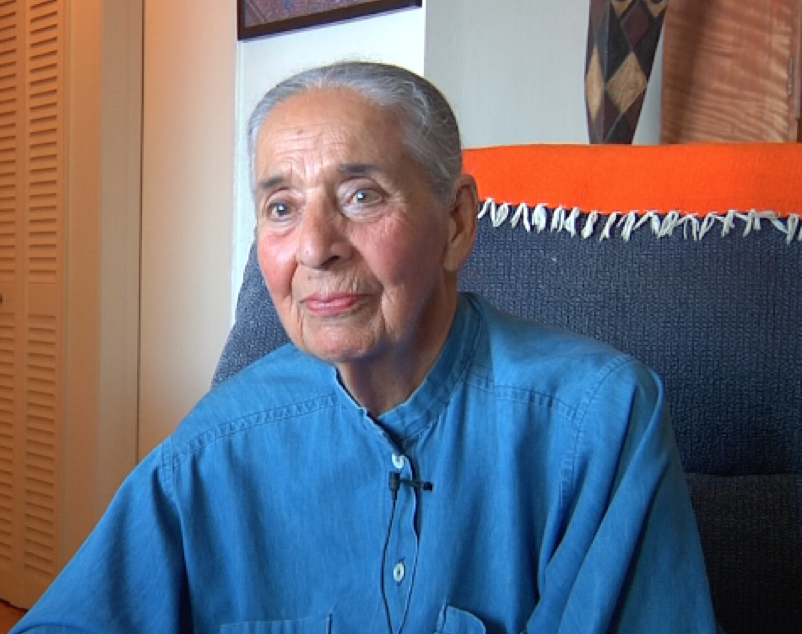
Born: October 28, 1920 (Maiquetia, Vargas, Venezuela)
Died: August 13, 2020 (Santa Monica, California)
Interviewed by Debra Burchett-Lere, Executive Director Sam Francis Foundation and Jeffrey Perkins, Artist/Filmmaker
Date: July 25, 2015
Location: In Luchita’s home, Santa Monica, California
Duration: 1:17:09
Initial transcription by Leila Elliott – 3.6.2016
Film by Jeffrey Perkins. Transcriptions edited by Leila Elliott (3.6.2016) and Debra Burchett-Lere (9.5.2020)
LH: Luchita [de Solar, Paalen, Mullican] Hurtado
DBL: Debra Burchett-Lere
JP: Jeffrey Perkins
JP: Well we’ve begun and this is actually an interview with Luchita Mullican [Hurtado] in her apartment here in Santa Monica, California and we’re so grateful. Debra Burchett-Lere has also joined us. We’re going to talk about Luchita’s memories about Sam Francis and living in Santa Monica Canyon and a number of other things we hope. Luchita has a very wide and spectacular background in the art world. Isn’t that so?
DBL: Yes, in her own right too.
JP: Did you meet Sam Francis when you first moved to Santa Monica Canyon? When did you first meet come upon Sam?
LH: I met Sam, I mean I knew his work of course, but I met Sam in the Canyon, yes. I told him how happy I was to meet him and I loved his work and all of that. He became a really good friend. Especially because I was also a friend of [artist] Liga Pang who was involved in his life for a while. Liga and I were very good friends. Everybody knew everybody in that canyon anyway.
DBL: Right.
JP: Yes, didn’t Sam move in there in 1964 or…?
DBL: ‘63 I think.
LH: I think it was, well I know I moved into the canyon in ‘51. Or was it? You see the thing is that my information can be unreliable.
DBL: That’s all right.
LH: I’m 94 so that goes with the territory. The alternative is not a good one so I’m glad I’m where I am.
DBL: Well dates –– that’s always hard to remember even anyway. Remembering from ‘51 that’s pretty good.
LH: It’s all right.
DBL: That was actually interesting so did Lee [Mullican] know Sam from before? From San Francisco? From the Dynaton days with Wolfgang [Paalen] or with Gordon Onslow [Ford]?
LH: I don’t remember him in San Francisco. In San Francisco Lee was staying with the [Jack] Stauffachers.
DBL: Who was Sam’s childhood school friend. They went to school together in elementary school.
LH: Well you see I didn’t remember that.
DBL: He actually worked for Lapis Press later, Jack Stauffacher.
LH: Jack Stauffacher yea. And Jack didn’t use a car; he only used a bicycle to get around.
DBL: You interviewed Jack?
JP: I did yes.
LH: He’s an interesting person.
JP: Very interesting, very peculiar and particular about this, that, and the other thing.
LH: Yes and very involved in what’s right and what’s wrong, you know.
JP: Yes, exactly.
DBL: Oh interesting. So were you in San Francisco in the late 40’s?
LH: Yes, I was married to Paalen.
DBL: You were married to Paalen then right. Then did you move to Mexico after that with him?
LH: Yes. I was married to Paalen and we came from Mexico because in Mexico I lost a child you see. A five-year-old little boy, Pablo [de Solar].
DBL: Oh, no.
LH: I had two children [from Spanish Journalist Daniel de Solar] when I married Paalen.
DBL: From your first marriage?
LH: From my first marriage. So I couldn’t live on in Mexico. It was infantile paralysis. It happened in a week's time. He went from going swimming and having all the energy and everything a child has to not living at all.
DBL: Wow, that must have been devastating.
LH: He ended up in an iron lung.
DBL: Well that was the timing of everything and Sam.
LH: No that was it. That was just before they discovered the injection.
DBL: The Polio.
LH: I remember calling my pediatrician in New York, Dr. [Hermann] Vollmer. He was famous in Berlin, he was Jewish and he left Germany just in time. He took all his furniture, he took everything he owned. They had this wonderful apartment in Central Park West. I still called Vollmer for any problem I had with the children. I called Vollmer and I said, “Pablo has infantile paralysis.” He said, “Well what kind is it?” I said, “It’s Bulbar Polio.” Then there was this long silence from Vollmer and he said, “Luchita, hope that he dies,” because he would have been a basket case.
DBL: Yes, well you know Sam [Francis] was almost told he would die and never walk again too.
LH: You’re blind; you’re a basket case.
DBL: So that’s why you left Mexico?
LH: Oh yes.
DBL: So Sam was there too, in ‘57, in Mexico. Did you?
LH: I didn’t know Sam in Mexico.
DBL: You didn’t meet him there by chance either.
LH: No.
DBL: It’s interesting these somewhat connections, you could have met but the timing.
LH: Well the people I knew then was Frida Kahlo and people like that. People would come; there was always a big influx of people from Europe and leaving.
DBL: Well that was the big Surrealist group.
LH: Surrealists yes, yes.
DBL: Then all of the relationship with Gordon.
LH: Yes, Gordon Onslow Ford
DBL: I love that period of the work that was being done in Mexico at that time, fairly political too.
LH: Yes, well that was the time of the Dynaton, the magazine, and the whole thing. Paalen did that single-handed, amazing.
DBL: Did you know Dorothea Tanning?
LH: Oh yes, Dorothea was there and Max Ernst was there. Yea, everybody was there. It was an interesting group. Dorothea Tanning was wonderful but what was her name? I don’t remember her name suddenly. She really was a very close friend. She made this wonderful box for her...she was married to Chiki [Emerico Weisz] at that time. She was married to Chiki who was a photographer and she had been with Max Ernst and she was an amazing painter.
DBL: Right, well we’ll probably remember it the minute we walk out of here.
LH: She was English and she was presented at court. There was a photograph of her being presented at court.
DBL: You know I think I know who it is.
LH: She was a Surrealist, the original.
DBL: Yes and she was from England. I’m just trying to remember because…
LH: Yes she was from England and there was a photograph of her in a tiara being presented at court that was amazing. She gave me a drawing, which now I don’t even know where it is. It was on black paper. Leonora Carrington that was her name.
DBL: Oh Leonora. So you probably have that drawing somewhere?
LH: Somewhere in my stuff yea.
DBL: Was that the time, were you in Mexico when all of the blacklisted writers from the movie industry were there like Dalton Trumbo?
LH: Oh yes, oh yes, [Luis] Buñuel came. A really interesting group. Buñuel I remember especially, because they brought their games with them too you know. You would have somebody in the group go out of the room and then the whole group would talk about something and then they would come back into the room and he or she had to figure out....
DBL: Oooo, how exciting! You would like that Jeff.
LH: You had to find out what it had been about, where the conversation had left.
DBL: The first Clue game before Clue. What happened to the…
LH: Including and that went with these drawings where you drew a figure and it was endless. Then the paper was opened and…
JP: The exquisite corpse yes.
DBL: Oh how fantastic.
LH: Amazing, they were fun things. It could get nasty, you see, especially with the one where people went out of the room.
DBL: That’s the juicy bits we’re asking about now. Who has the Buñuel archives do you know?
JP: I don’t know but he was the director of the film at MoMa for a number of years before he went to Mexico.
DBL: So maybe MoMa has it.
LH: The eye thing was very famous, where the eye is cut.
JP: Un Chien Andalou.
LH: Un Chien, yes. With Dalí.
JP: With Dalí? They made two films together.
DBL: Well Jeff’s made a film about FLUXUS. He knows a lot about the FLUXUS artists too.
JP: Yes, I mentioned Alison Knowles to Luchita. She knew Alison Knowles, which is such a surprise.
LH: Yea. I hadn’t heard that name for ages you see. I lost it. There was this whole group that in my life, they were very important in my life and suddenly they surface.
DBL: It’s interesting when you look back all the different mini-lives you’ve had.
LH: Yes, yes and I’m ninety-four so that’s a lot.
DBL: You don’t know where a lot of them ever were but at the moment that was it.
LH: That was it yea.
DBL: So did Sam ever meet Wolfgang then or had he passed away before Sam met him?
LH: Who?
DBL: Paalen. Did Sam ever meet Paalen?
LH: No, no.
DBL: Because he had already passed away.
LH: Well you know he committed suicide. That’s why, you see, he didn’t want children. He didn’t want children because he saw two of his brothers commit suicide.
JP: He too also committed suicide so the three brothers all killed themselves?
LH: All three committed suicide.
DBL: Wow.
LH: That’s why he didn’t want to pass on this legacy. He was an adventurer; he was the true kind. I’ve seen him drink a glass of water with things swimming in it.
DBL: He didn’t care; he would try anything.
LH: No, if he was thirsty he was going to drink it you see.
DBL: I see. How long were you with him?
LH: We were together, I don’t remember. You see these are the things.
DBL: Well you had your son?
LH: No, you see, when we married he said, “I don’t want children.” So I said, “ I understand that, I have two sons and I don’t need other children.” I was in love with him and I loved him and it was an extraordinary life.
DBL: Well he was an interesting person for sure.
LH: They used to call it neurasthenic. Neurasthenic people were people with nerve problems. He had that; he became very depressed at times for no reason. With someone like that you have to find the key to getting him back to be involved in life.
DBL: So you met Paalen in San Francisco?
LH: I met Paalen. Where did I meet Paalen? No, I met Paalen at a show he had, a wonderful show. I forget where it was – it was in New York. I went with Noguchi as a matter of fact, Isamu was a really close friend. We went to this opening and there was Paalen. I think he invited me to go to the Museum of the American Indian. We began to talk about the new heads that had just been discovered in La Venta. I was very involved at that time, well I still am you know. He told me then that there was this great museum and I had never been to the museum on 169th, 165th street, somewhere in there, the American Indian. He took me and I remember walking towards the entrance to the museum and I saw a necklace and I thought, “Oh that looks Egyptian.” I’ve always loved Egyptian things. And as I grew closer I realized that the necklace was made of human fingers. Instead of being Egyptian, a whole new world opened up! With dirty nails!
DBL: Oh wow. I wonder if that’s still there?
LH: Who knows? They still own it.
DBL: So that’s how you met him, in New York.
LH: I met him in New York.
DBL: So are you originally from New Mexico?
LH: No I’m Venezuelan, I was born in Caracas.
DBL: Interesting and then you made your way up to the United States?
LH: No, there were three sisters in Venezuela, in Caracas. The youngest sister had a friend and her name was Margo. Margo’s friend invited her to come to New York and so she took off to visit her friend in New York. Of course was delighted with the freedom. In Venezuela at that time, a woman if she was driving or committed some kind of naughty thing, according to the law, they would say, if she ran over somebody or if she hurt anybody, they would say, “Where does your husband work?” And they would go and arrest him.
DBL: Wow, incentive to leave.
LH: No and if she wanted to leave the country, then she would have to be signed out by her father, her husband or a judge. It was a different atmosphere from New York where you had real freedom to be who you were, follow your interest. So when Margo left, her other sister Marietta, was the middle sister, left and she married a Spaniard. They had, I don’t know how many children, they had many children and she had a wonderful life. He was a jeweler. Then my mother was already married and she had children. They invited my mother to come and so my mother left. So I have no memories you see, my mother left when I was too young. She left me with my brother; I had a brother younger than I. She took the oldest sister, Maria Cecilia who became Mary. And took off…
DBL: Then you ended up going to New York after?
LH: No, I ended up staying until I was eight years old. You see. I stayed with my two aunts and I lived a very nice life with them, very happy, with my brother. There were two aunts, one very tall, as I remember, dark and tall who looked after my brother. The small-shriveled kind of aunt loved me especially. Her name was Manana and Manina. Manana was my aunt who looked after and adored me and it was a simple life and it was lovely. When I was eight years old my mother came back for me, I didn’t recognize her.
DBL: Oh she came back? To bring you back to New York?
LH: When I was eight.
DBL: And your brother too?
LH: No my brother she left, she left my brother. Because my father and my mother had parted ways. She had left and she didn’t want to be married to him anymore and he didn’t care about her. Those are my last memories of my father you see. He was very important to me then. I didn’t see him again. I didn’t see him again, ever. So he appeared to me a couple of years ago. After you wake up in the morning you start thinking about your past and your childhood and there was my father. Suddenly I saw his face. I saw his face appear. I have a scar under my chin and I was touching my scar and suddenly I remembered how I had it, how I came to have that scar. I was waiting for my father in this house, and I saw the door. We lived on a hillside and I was waiting for him – this heavy door and I saw him turn the corner, coming up. And I ran towards him and I tripped and I remember the blood on my white dress.
DBL: So you’re just remembering this story after all this time?
LH: Then I saw his face, which was amazing. I was so happy to see it.
DBL: That’s great, that’s good. So from New York you learned, did you learn art there?
LH: I learned the language. I met my cousins. It was a completely different language. I didn’t understand a thing at first but then very quickly I did speak English. Then I had very strong likes and dislikes. I knew I was going to be an artist. I went to school in Washington Irving because I was painting, I was drawing. It was an all girls’ school at that time, Washington Irving; it was somewhere lower than 14th street. It was an all girls’ school and known for its art courses. We lived at Dikeman Street, which was, you know, way uptown.
DBL: You went a long way to go to school.
LH: Yes.
JP: As far uptown as you can get really.
LH: Yes, yes. So I would travel every morning and every afternoon all the way because I was interested in the art courses. I remember I got to do the cover, we had a yearly magazine and I got to do the cover of the magazine and I was so proud of it.
DBL: That’s great and so when did you meet Lee Mullican then?
LH: Well Lee Mullican you see was part of the Dynaton.
DBL: So he was part of the group already, you knew him already with Paalen?
LH: I knew him you see. Then what happened was that I lost my child, infantile paralysis.
DBL: Then you went to San Francisco?
LH: Then it was that I had to have another child. I really needed a child.
DBL: I can understand that because I have three boys.
LH: So everybody understood what the situation was. I fell in love with Lee and Lee fell in love with me and the thing was a natural thing to happen. I remember my son interviewing us because he did a film about his father and he interviewed the two of us.
DBL: Together?
LH: Yes, together.
DBL: I will have to look at that, I want to see that.
LH: Yes, at one point John said something about, “How did you get involved with each other?” We looked at each other and we said, “We danced.”
JP: That’s exactly what my mother said when I asked her that same question.
LH: No really? Well that’s.
DBL: The chemistry, you just had to have the dance together and that was it.
LH: That’s it.
JP: If you could dance well with the person. It’s kind of an important thing.
LH: Yes it is.
DBL: You have to know how to dance in those days.
LH: Oh yes, I enjoyed it and so did Lee. He could jitterbug and he was huge you know.
DBL: Oh yes I remember. He’s from Oklahoma right? Is he part Cherokee?
LH: Chickasha, he’s from Chickasha.
DBL: So he had no Native American in him? Cause he had a lot of features I thought?
LH: He liked to think he did. At that time it wasn’t considered smart to be part Indian. So the family did not try very hard to find out if they had Indian blood because it wasn’t considered smart.
DB: Not like now, no. So we’re back to Santa Monica then, you made your way back to Santa Monica and you met Sam in the neighborhood. Was he at that time?
LH: He was married to Mako [Idemitsu].
DBL: He was married to Mako, so early 60’s and the boys were being born.
LH: Yes, he was married to Mako and you know Sam always played around, let’s face it. He loved women. I never found any part of it involved me, but I saw him with my friend Liga [Pang] and I saw how unhappy she was with all this. I saw Mako – how unhappy she was with that too. So that when Margaret [Francis] appeared and there were these photographs of the wedding that was not to be believed. I mean Sam in a tuxedo and Margaret in that white faced apparition you know.
DBL: Yes, their Shinto ceremony yea.
LH: It was quite a shock for all of his friends. Then he invited us over, including Anne?
DBL: Anne Howe? Anne Howe, Ed Janss’s wife.
LH: Yes, Ed Janss’s wife. He invited Anne and me and I forget who else, but there were a group of women. He said, “I want you to meet my wife and I want you to be nice to her and I want you to accept her as a friend.” He had us promise that we were going to be kind to Margaret. It was true, we were . . . we did. Then you see, Margaret came as a painter, but when I first met Margaret she painted little rabbits. A huge canvas you see, and she said, “There are one hundred and twenty rabbits in there.” We couldn’t believe it you know. I mean Sam had to do something about those rabbits. So the lessons began.
DBL: She was trained in Japan with a probably more traditional art world.
LH: Well I’m sure, I’m sure. He had her doing big stroke things immediately. They immediately got rid of the rabbits and everything else. Margaret was painting interesting paintings.
DBL: Were you able to talk to Sam about any of this personally, one on one, without the group of people or was that just something that just never got discussed again?
LH: Well Sam went through hell you know. He had a hard time leaving this world and there were things that were very unhappy. Margaret didn’t believe in certain things. She said she didn’t want any interference because this was a real cure. She wanted to cure Sam but Sam was in terrible pain. It was a terrible time for Sam.
DBL: Did you know, you knew obviously his children fairly closely then?
LH: Shingo was marvelous. He would push Sam around in his wheelchair and he was there for Sam. I didn’t see Osamu because Osamu always had that drug problem.
DBL: He was in Japan I think.
LH: He was in Japan with Mako because it’s the only place that he doesn’t, in New York he does drugs.
DBL: What about Kayo? Did you know Kayo much too?
LH: I didn’t see much of Kayo no, Kayo was never much around, no. She wasn’t present at all.
DBL: Was John, did John hang out with Shingo?
LH: No, they’re not the same age. No they’re not involved. John’s much younger.
DBL: Matt was probably older? Osamu was born in ‘66 and Shingo was born in ‘69.
LH: Matt was born in ‘51. I think probably Matt was by then somewhere else. He went to Cal Art’s first graduating…
DBL: First class from Cal Arts? Oh wow, that’s great.
LH: Yes and they made the hallways in Cal Art’s wide enough for the beds; wide as a hospital’s hallways because if it didn’t work as a school it was going to work as a hospital.
DBL: Oh that was the plan b for Cal Arts?
LH: That was the plan b for Cal Arts. I think it was John Baldessari who really made that school. The first class was David Salle, and I don’t remember their names anymore.
DB: Was Michael Asher there?
LH: Yes Michael Asher, it was an incredible group.
DBL: It was an incredible beginning.
LH: Matt [Mullican] they called the “Night and Day man,” because he was always involved in the big studios and all the machines. I have a piece that Matt did there, of his footprint in the sand. It’s an abstraction. You wonder, “What the hell is that?” It’s a photograph of his footprint in the sand, it’s an abstraction, and it’s interesting. They could do things like that and besides, have John Baldessari as your mentor, have a good time.
DBL: Yea, it would have been a fun class to be in that first class for sure.
LH: Now they’ve become friends and they did a piece together.
DBL: Oh, well there you go. In the Santa Monica Canyon, I remember there were a lot of other people who lived there, like Anáis Nin?
LH: Well my neighbor was what’s his name…
DBL: Ry Cooder?
LH: No, no, that was later. My neighbor then was Christopher Isherwood.
DBL: Oh Christopher Isherwood, fantastic.
LH: Christopher Isherwood was my neighbor; we burned papers in the same. It was at that time that Christopher had written that marvelous thing that was made into a film.
DBL: Yea, the book.
LH: Yes and she volunteered and I was always there and there was always an incredible group of people.
DBL: You would just go hang out with each other, like with Sam and have dinner?
LH: Yes, yes. We burned our papers in the same thing, in the same place. I’m having so and so, famous people, and you’d be invited to these things and sit there and wonder at these incredible personalities.
DBL: Did you meet any of Sam’s dealers when they came back and forth, like Mr. Kornfeld from Switzerland?
LH: Oh yes, oh yes. There was one man who came…
DBL: Pontus Hultén?
LH: Oh yes, Pontus became very involved.
DBL So, looking at your work too and Lee’s work.
LH: Yea, it was an interesting time.
DBL: I guess at that time too there were a lot of other people that you had as mutual friends.
LH: Yes. Well in New York I was at that time too because I stayed with, when I was living with Paalen in Mexico I’d come and stay with [artist] Jeanne Reynal at 240 West 11th street. What was the name of the man you told me about a little a bit ago, Nude Going Down the Stairs…
JP: Marcel, Marcel Duchamp.
LH: Marcel Duchamp, I met him at Jeanne Reynal’s.
JP: Sure they were countrymen and probably friends.
LH: Exactly.
DBL: Did you see Pasadena had the Duchamp show?
LH: Oh yes.
DBL: That was an interesting period then. Everyone was involved with Walter Hopps at that time.
LH: He was always very mysterious, Marcel. He didn’t want Jeanne Reynal to say that he had helped her hang her show. She did mosaics, that’s one of Jeanne Reynal’s mosaics there.
JP and DBL: OH. Oh yes.
JP: It’s very heavy. It’s in concrete; it’s a heavy piece.
LH: Yes, it is a heavy piece and those are semi-precious stones and she’d be in the back cutting the stones in the back, in the garden.
DBL: Did you ever go to Paris with Sam? Or Japan?
LH: No, no, I never traveled with Sam.
DBL: You never went on trips together like that?
LH: No.
DBL: I was just thinking about music and literature because he was really involved with…
LH: Well he would see the things that I’m involved with, that I was painting. He was always really helpful and really gave me good advice. He said, “This is fantastic” and “Carry on this way.”
DBL: So you would talk about art, about your work?
LH: Yea, yea.
DBL: Would you talk about his work?
LH: No, no. But I appreciated his comments, I really did. I did a lot of self-portraits, which he really liked. I haven’t done any more ever.
JP: Which he eventually went on to make as well. He made a number of self-portraits too, later I think, in the 80’s was it, Debra?
DBL: Well yea, 70’s and 80’s when he was involved with the Jungian group.
LH: The Jungian thing yea. Then of course Nancy Mozur is one of my best friends.
DBL: Right so you met her from the early days.
LH: Yes. I met her in the early days.
DBL: Oh that’s good, yea. Are you involved with the Jungian?
LH: Well I think he had a lot of things to say and I approve of them. I think he was certainly more interesting than the rest of the groups functioning then. I don’t think it’s all sexual, I don’t.
JP: That’s a good comment. Were you in the women’s group?
LH: I was.
JP: You were a member of the women’s group?
LH: Oh yea, very involved in the beginning, with Joyce Koslov.
JP: Right, Max Koslov’s wife I guess.
LH: From the very beginning, Joyce invited all of the artists to this meeting. We all went and we all got up. I remember standing up and saying, “Luchita Mullican.” And I heard a voice from somewhere say, “Luchita what?” [laughs] I said, “Luchita Hurtado.”
JP: Oh I see.
DBL: Right, go back to your maiden name. Well that’s true.
LH: It was very strong. Then you see, I belonged to this group and the group consisted of Vija Celmis, Alexis Smith, and me and Amanda . . . no. . . what was her name? She was a filmmaker and I haven’t thought of her in ages.
JP: I know her, dark haired girl.
LH: Dark hair.
JP: A Greek name.
LH: Greek name yea, exactly. You knew that bunch?
JP: I did yea and Judy Gerowitz.
LH: Yes, Judy Chicago.
JP: And Mako Idemitsu as well.
LH: And Mako was part of it too.
JP: And Ry’s wife, Susan Titelman.
LH: Susan Titelman, Susie I still see.
DBL: Yes, she was part of the neighborhood too.
LH: Yes, Susie and Ry became very good friends. We still are, as a matter of fact she just became a grandmother.
DBL: Oh great.
LH: Joachim had a child – a very important time for her.
JP: There was also a men’s group that I understand.
DBL: That Sam tried to develop.
JP: In parity to the women’s group. Right?
DBL: Right, but that wasn’t just necessarily related to Jungian. The women’s group was Jungian.
LH: It was Jungian yes.
JP: Oh really?
LH: Yes.
DBL: The men’s group was more artists . . . Ed Moses.
LH: Yes, Ed Moses that was right.
DBL: And Jim Turrell and Bob Irwin and there was a group that Sam was trying to get together to kind of have art, be an art place where they could talk about ideas and things.
LH: Then what was, the Grinstein’s were really important.
DBL: Oh yes, Elise and Stanley.
LH: They had these parties every Saturday or Thursday, but they’d open their doors to the art world and you could go there. It was, well who was it that said it was a nursery for artists. There was one room for the dancers and one room for the viewers of TV, and that’s still standing. Happy Price and I went through that house and we kept saying, “Oh my God, do you remember this and that.” You know Happy has a house in Taos too, still, but she comes here occasionally. She’s coming here during the winters. I see her occasionally, and she has children.
JP: Well there was quite a vortex of energy in that Santa Monica Canyon.
LH: Oh there was.
JP: Bachardy, Don Bachardy was it?
LH: Yes, I see Don still. I mean we had dinner the other day.
DBL: Oh yea, how is he?
LH: Yes he’s been part of my life for a long time.
JP: Then there was this Superman lady?
DBL: Noel [Neill] Lane.
LH: Yes, that’s right.
JP: Was that Noel? She lived right above the pool there I remember.
LH: Yea, yea. Then there was this woman who had two children. I forget her name. She had a lot of money, she was very rich. She had this big house.
JP: Is this Betty Freeman?
DBL: No not in the canyon.
JP: Oh in the Canyon then.
LH: In the canyon yes and she had these two children and one was going to school in Chicago, a girl. The other one was, I think Cal Arts. The police called her and said it involved the girl in Chicago. She was murdered. Then the next day they called her from the school and they said that her son had been in the tub, with the radio or something on the edge, and he had been electrocuted. Both children she lost.
DBL: Wow, and tragic experiences.
LH: It was just beyond comprehension and she functioned. She still was functioning and she was doing films.
JP: That’s an amazing story.
LH: Amazing story that this can happen, that this woman survived that.
DB: So George Wagner lived in the canyon too?
LH: That’s right. I don’t know what he’s doing now.
DBL: Do you know Martin Wasserman? He’s a therapist.
LH: I don’t remember.
DBL: I don’t know if he’s Jungian but Sam had done a painting of his son. Talking about tragedy had died young in an accident bicycle or skateboarding in the canyon. Sam dedicated a painting and wrote this beautiful little saying on the back of it for his son. Well it sounds like, were you able to walk around and knock on the door and say, “Hi, let’s have a beer?” It was that casual with Sam in those days?
LH: Oh yes, yes it was. Or Sam would call me and say, “We met an interesting man I think you’d like to see him, could we come by?” I’d say, “Well I’m having liver, if you don’t mind, if you like liver come and have some with me.”
DBL: You’d also eat at his house probably around the big dining table too?
LH: Right, right. It was very relaxed. I could go up and down those stairs twenty times, it did nothing to me. It’s really what’s kept me moving at ninety-four.
DBL: Steps are important in a way yes. In terms of his work, you probably never watched him working?
LH: I got involved, I really got involved. I loved it. He was doing these great watercolors that just floated, that just did these beautiful things that were absolutely gorgeous. It was amazing, it was a good time. I felt very lucky to have Sam there.
DBL: What do you miss about him? When you think of him, you mentioned earlier his eyes.
LH: I smile, I always smile. That’s what I think of when I think of Sam because he had that natural joy, those wonderful eyes of Sam and his laughter. He enjoyed being alive and you could feel that. You feel that in people, this joy of life. He had that very strongly and laugh, you know, wonderful man. Very positive. There are positive people and negative people and Sam was certainly positive.
DBL: You still see Liga [Pang] now; she’s living back here right?
LH: Well I see Liga now but we aren’t that close. I always think of her and would like to see her. I don’t drive anymore. That’s my problem too because it’s not the way it was. You don’t just get into your car and say, “I’m coming over.” She has other friends too. It happens, people come together and they come apart.
DBL: You probably knew a lot of the studio people too, like Nancy and George Page and Jerry Sohn.
LH: Well I have different groups. There’s a group that comes and takes me to the market on Wednesdays and they are sort of sixty year old people, fifty year old people and I’m grateful. They have the energy and I don’t. They’re willing to walk slow.
DBL: To go to the Santa Monica market?
LH: We go to the Santa Monica market. They’re patient.
DBL: You go with Nancy [Mozur] ever?
LH: Nancy I see. Then there’s another group that takes me to meditation and they’re much younger. I go to meditation every Wednesday and that’s an important part of my life too. So I’m very fortunate and they come for me.
DBL: Is it a Buddhist temple?
LH: No this is Abby? Do you know Abby? A very rich woman, she has this beautiful house on top of this hill in Pacific Palisades, Abby somebody, very rich. You sit in this absolutely gorgeous wood paneled room in the middle of this gorgeous garden filled with trees that you’ve never seen anywhere else – and meditate with a group. Sometimes it’s very small, sometimes it’s twelve, fifteen people.
DBL: Wow, interesting.
LH: Then you meditate on your breath or you meditate on whatever sound. It’s really a very important part of my life.
DBL: That sounds wonderful.
LH: So I can’t complain. I’m lucky, very lucky.
DBL: So I was just thinking in terms of Sam, did you go to a lot of his shows and openings ever with him? I know he wasn’t very social about that.
LH: Yes, yes. I loved his work and I loved seeing what he was doing and going to his studio. I saw him do that marvelous piece on the 4th floor and I didn’t realize he wore these booties.
DBL: The little socky booties. In the Frank Gehry building, which we’re going to have to figure out which one that is, if it’s Portugal.
LH: It’s on the fourth floor, on the very top. It's this beautiful big mural, beautiful big. It’s painted on canvas. It’s a really wonderful painting. Not many people get to see it because nobody knows about it.
DB: JP Morgan didn’t have Frank Gehry do something for them did they? Where the Chase Mural is? Jeff you just saw that not so long ago.
JP: The Chase Mural?
DBL: Yea.
JP: I don’t know if I’ve ever seen it actually.
DBL I’m trying to think about what that could be. Now you’ve got me intrigued.
JP: The Queens museum or was it exhibited at the Queens museum?
DBL: Did Frank do the Queens museum?
JP: You’re talking about the Chase now, not the Guggenheim? Luchita you mentioned that it was in Guggenheim Bilbao in Spain.
DBL: You think it was there? Fourth floor? I don’t know. I’m going to have to look this up. It’s very intriguing.
JP: You described the building and that sounded like the Bilbao museum in Spain.
LH: Well it could be, this could be. As I say, sometimes things get mixed up.
JP: Did you ever watch Sam Francis painting?
LH: Now that’s a hard one because I was in and out of his house so much I don’t see how I could have missed it. I’ve watched him work, I know that but to think of a particular painting or a particular anything, no. I saw him do very small things, which I was amazed at. You know little things that were amazing.
DBL: Right. He would do those often on the coffee table or the kitchen table or dining room table. That little quick facile hand of his.
LH: Yea, yea, nice. I remember the studios, those wonderful studios of his in the canyon.
DBL: Do you have any work of his?
LH: No I don’t have any.
DBL: That’s interesting. Did he have any, he had some of Lee’s, and I think I remember in the Estate there was some work of Lee’s. Not of yours I don’t think. Did he have any of yours?
LH: No, no, as I say I was doing self-portraits and I don’t think I ever gave him anything no.
JP: I like your cat.
LH: What cat?
JP: The one at your feet.
LH: Oh this one. I used to have, you know when I moved into the canyon I was invited to a party and this woman, I was talking to her, she was a stranger, they were all strangers to me, and she said to me, “Have you heard about the new person who’s just moved into the canyon? She has a Picasso and thirteen cats.” I said, “That’s me.”
DBL: You had thirteen cats?
LH: I had thirteen cats, but it was temporary. I had Sue Emma who was a Siamese cat. You know they’re part monkey, they can climb anywhere and they perch on top of a narrow ledge. They are amazing cats. I had two mamas and together we had thirteen cats. I did have a Picasso at that time.
DBL: No cats now and no Picasso!
LH: No Picasso, no cats.
DBL: It’s probably easier that way.
LH: Much easier life.
DBL: Sam, that’s interesting, he must have liked that about you, that you had so many cats and pets. He loved animals too.
LH: Yes, yes. Cats are people; really, they have feelings like people have feelings. I had a cat, Pichano, I’ll never forget, it was in Mexico when I had this grey cat. He was always so attentive and lovely. I think he was a homosexual cat. He loved my shawl; he had fun with my shawl. One day I couldn’t resist a bird, you know in Mexico they have these birds on strings and you buy the bird with a string. I wanted to take it home and then free it for a while, you know have him for a little bit. I brought the bird home and the cat never forgave me. His feelings towards me changed. No more of this rubbing himself and then sitting on my lap and all of this. He took it seriously. No you have your bird, you keep your bird.
DBL: Very jealous. So what did you do, you had to let the bird go?
LH: I let the bird go of course.
DBL: I’m surprised he didn’t eat it, try to eat the bird!
LH: No he didn’t, there was no question of that. He would sit atop the cage, wait for the right moment that never came.
DBL: You know Sam; you were lucky because you were at the West Channel house with his library with his books. Did you ever get to explore some of the books he had in the library?
LH: No I never did. I collect books too, so.
DBL: It reminded me of his library looking at your bookshelf.
LH: I love books. Matt had so many books published about him, he stopped sending them to me.
DBL: Yea, he’s a good artist. What about writings? You know Sam; he used to write a lot of poems. Did you ever spend time with him talking about it?
LH: Yea, I think I did but it’s all kind of all-together in my mind.
DBL: Because a lot of it was dreams, in the Jungian, recording his dreams.
LH: Oh yes. Well we all did that. Even today I find masses of these little black bound books, dreams that go back to 1950-51.
DBL Did you know Ann McCoy?
LH: Oh yes we were very close friends.
DBL: We’re trying to interview her now too.
LH: Where is she?
DBL: She’s in New York.
LH: Oh she is. She was out here a long time. A lot of people from New York are moving back. Don’t you feel that’s true?
JP: I’d like to.
DBL: You’d like to move here, back here?
LH: Why don’t you?
DBL: You have your property, you could move there now.
JP: No. We can’t talk about that.
DBL: You could still move here.
JP: I could, I’m just involved in a project and I have to be there now. Maybe after I finish that I’ll be able to move.
LH: It’s a very pleasant place to be.
DBL: Except for the driving sometimes.
LH: We don’t get enough rain, that’s my only complaint.
DBL: That’s true, we don’t.
LH: There’s not enough rain. But otherwise who has any complaints? There’s nothing to complain about.
JP: I noticed no dog turd on sidewalks and no gum on the sidewalks either.
DBL: In Santa Monica that is. Come on over to the eastside of town where I’m from, you’ll see all of that.
LH: In New York what always got to me was that yellow snow.
DBL: What gets me is the trash on the streets in those bags.
LH: The whole thing. It’s depressing.
DBL You’re walking by in your mink stole and you have these piles of trash at your feet. I find that odd but it’s the sound of the trash cans and the bins, this is what I’ve been told, that it echo’s so much that it’s better just to throw…
JP: No, no there’s just days of trash pick-ups. Then the supers put them out.
DBL: But why aren’t they in cans?
JP: All the supers have their system. There comes a day and a time when the trash bags all go to the curb. The companies come and load them in the trucks and take them away. Most buildings, the most expensive ones, you never see it. My building for example, you have little trash receptacles outside.
DBL: No because I asked about that and they said because of the sound. I asked, “Why don’t you have plastic trash can and lift it up like you do here?” It’s the sound of the garbage truck that has that lift thing, it’s so loud. The echoing in the cities, I think is one of the reasons why they don’t do it.
JP: It is a system that’s very well organized.
DBL: It’s old like that.
JP: Well there’s some that do that and then some neighborhoods that don’t.
DBL: But it’s an odd thing, yellow snow. You can look in and see there’s obviously some very expensive trash over here and not so expensive trash over here.
LH: No it’s true. It’s a much more comfortable life here. I mean going up and down those stairs and the masses of people going across the street.
JP: The subways.
LH: The subways and all of those stairs here and there. I had the energy before but I don’t have the energy now.
DBL: Yea, it’s hard as an elder person to live in New York, that’s true.
LH: I had a friend in New Mexico who moved to New York. She was a part of Agnes Martin’s group. Agnes became a very good friend with me. We became very good friends. Agnes was quite an extraordinary woman. She worked till the end, I mean she was amazing and devoted. She would invite me. She would send a truck from New York to pick up her things but she didn’t sign anything until it was time to load her paintings onto the truck. So she would sit there and sign all of this work that went straight to the PACE gallery.
DBL: Was that just because that was her way to control? To the very end?
LH: That’s just the way she did it, that’s the way she did it all her life. To watch her paint was amazing. Sometimes I’d go there, she had this little place, and you wouldn’t believe it.
JP: I heard that.
LH: Amazing. It was a rocking chair where she sat and another rocking chair right next to it. I remember sitting in that rocking chair with Agnes and talking. I remember one conversation with her, I was complaining about something about my paintings and she said, “You know Luchita you have to decide, you either have children or you’re going to be a painter, you’re going to be an artist.” She said, “I’ve had too many children and this lifetime I decided I was going to be an artist, but you can’t have both.” Suddenly I thought, “My god she’s right.”
DBL: That energy that you need to devote.
LH: The energy that’s needed. If your child sneezes it takes away a whole day. I mean it’s shot. You have to be willing. I said, “You know, Agnes, you haven’t had all those children.” She said, “But that’s this lifetime, I’m talking about the past.”
DBL: How long did she live in New Mexico?
LH: A long time.
DBL: She was there a long time.
LH: She had a martini for lunch every day of her life.
DBL: Oh how fantastic.
LH: And she drove. You closed your eyes when Agnes was at the wheel, my god! Somehow she made it but, wow. You had to trust her.
JP: There’s a really beautiful film about her. Unfortunately I never saw. It played for about a week in New York. Painter friends of mine saw it and they said it’s just extraordinary. That her lifestyle devotion to her work was so particular.
LH: It was amazing.
JP: And you can see it in the work although, it’s difficult to imagine, just looking at a painting you couldn’t imagine that somebody actually lived it.
LH: Yea, she did, she lived it.
JP: In New Mexico right?
LH: In New Mexico.
DBL: Yea, she was very separated from the scene and everything.
LH: Oh absolutely.
DBL: In a way Sam kind of was here even. He had a lot of friends but he wasn’t as well known with the galleries and the critics and all of that. He didn’t like to go to openings too.
LH: Agnes would take off because someone with a yacht in New York would send this limousine to pick her up and take her to New York and spend time on the yacht, right. She would come back and I’d say, “How was it?” I wanted to know all about it. She’d say, “People who helped serve stuff on the yacht wore white gloves. That’s all she could remember or that she was interested in. They were all wearing white gloves. I said, “I want to know about the people,” but she hardly paid attention to anybody. She didn’t.
DBL: But she still went on the adventure.
LH: She still went and she had fun obviously. It wasn’t that she didn’t enjoy it. She’d try getting her clothes together to go and she loved clothes but she didn’t know how to choose them. It was strange. She chose the wrong things; she chose turtle skirts or something that did really nothing for her. I would help her with that sometimes, I would say, “No, why don’t you do this,” or I’d take her something. She’d appreciate it. She’d go like this on the cloth and say, “Oh I like this.”
DBL: So in New Mexico, when were you there? Was that in the past twenty years?
LH: Oh that was in the past, yea.
DBL: Was that after Santa Monica or before?
LH: When my husband was still alive so it was in the 80’s I think, 80’s, and 90’s.
DBL: So did you meet Georgia O’ Keefe?
LH: I met Georgia O’ Keeffe but it was so unpleasant. Because by then, this man who lived with her was so nasty. I didn’t appreciate that. It was uncomfortable. We were having lunch and the last time I saw her I thought, “Never again, I’m never going to go there for any meals.” You know we are all sitting at the table and having conversation and talking and suddenly he notices that she doesn’t have her false teeth in. There’s a bridge that she has to put on. It obviously is uncomfortable and she tries not to listen and he insists, “Go and put your teeth in.” You know, rude, really being rude and you feel for her. You don’t want to be there.
DBL: What about other artists? Was Larry Bell living there?
LH: Oh Larry yea, Larry Bell was there.
DBL: And Meibao, Meibao Nee?
LH: Meibo was there. She had a very nice thing going on there. We had very good times. Then what was his name, I mean, he got into the liquor.
DBL: Oh Rod Cooper.
LH: Cooper, yea.
DBL: The mescal, he makes those beautiful mescal bottles.
LH: Mescal yea and I think it was Kenny…
DBL: Ken Price did the labels.
LH: Kenny did the labels yes.
DBL: So Kenny was there too?
LH: Yea, Kenny was there; Kenny and Happy both became very good friends too. Kenny got sick and it was so sad. I think her daughter is still there, Rami. Both daughters look just like Happy. Happy has strong genes. Happy’s from Santa Barbara, a very rich girl.
DBL: So did you live in Taos area or near Santa Fe?
LH: No, we lived in Taos. We had right on the main road there.
DBL: So Doug Wheeler had a place, did you ever?
LH: Doug Wheeler I don’t remember at all.
DBL: Bruce Nauman? He and Susan Rothenberg?
LH: Yes of course. There were a lot of people there. There was this man who was really part of Agnes’s group, I mean he looked after her. He was really involved with her. I don’t remember any of the other names. Now you know, so many years, it’s all gone. I still have the house but as I say my son doesn’t want me to be living alone there.
DBL: Yes. You just go there for visits?
LH: When I go, I go to visit and stay with a friend. Her name is Judy, Judy Kendall. I stay with Judy and see old friends. There was this woman who does a lot of traveling, she’s very rich, she lives on a hill and I’ve forgotten what her name is.
DBL: She lives on a hill in Taos.
LH: In Taos yes. It’s a lovely place but you know, it’s all gone. Isamu’s [Noguchi] sister bought a house in Santa Fe but not in Taos.
DBL: Does Larry Bell still go back and forth?
LH: Larry has a place here and a place there. He’s still there yea.
DBL: So did you ever do any prints with anybody? At Tamarind?
LH: Yes I did. I did prints with the woman here, what’s her name? June Wayne.
DBL: Oh June Wayne, yes. There was just a big exhibition of her work at the Pasadena Museum of California Art.
LH: Yes, June. You know back then…
DBL: So you never worked with Sam at Lapis or at the Litho Shop?
LH: No, no. As a matter of fact no I didn’t. I did with June Wayne but not with Sam.
DBL: Well we probably should, you’ve talked a lot!
LH: I know, I know.
DBL: We don’t want to talk you out.
LH: I know. You’ve talked me out.
DBL: Now you’re exhausted! This has been great, really wonderful.
JP: Thank you very much, Luchita.
DBL: Yes, thank you, Luchita.
LH: Well you’re very welcome. I hope I’ve contributed something.
JP: A lot.
LH: I’m very fond of Sam still. I’d love to see the project when it ends.
DBL: We will.
JP: Is this project ending? I don’t think so.
DBL: The never ending Catalogue Raisonné and never ending oral history project.
LH: Are you going to publish?
DBL: Yes. Right now the Getty is interested in making it into a kind of a special thing.
LH: The Getty I think is on its toes, it’s good.
DBL: Yes, they’re starting to be more so, yea. The Archives of American Art also, you actually have a nice interview there.
LH: Yea.
DBL: That was done in ‘94 I think.
LH: Long time ago yea. I remember I forgot about the interview. It was set for ten o’clock in the morning and I had completely forgotten about it. I got home at noon and there were these people waiting, standing, waiting by my door. I’ve never felt so guilty. It was awful. But then you know, I had the interview.
DBL: It’s a good interview.
LH: It turned out all right.
DBL: Well it’s all-good, all of the layers of Sam and the world. Then what you contributed in your own ways and everybody. That’s what’s so great about doing these kind of oral histories is because we are not only learning about Sam, we’re learning about the period and the time and you. Then your stories goes off to another story, which makes me think, “Oh we need to go interview so and so.” So that’s what’s great about this. The family tree in many ways.
LH: Yea, yea.
DBL: For you doing it, that must be so interesting, how one story leads to the next.
JP: Yes I’ve learned a lot about Sam.
DBL: So I don’t know if you had a copy of the film but I brought it for you, the Jeff Perkins film.
LH: Oh how nice. Thank you so much.
DBL: So you can watch it sometime. It’s actually very nice.
LH: Oh here, oh marvelous. Thank you so much. I look forward to this.